
Who this is for
- Healthcare general contractors bidding or running tenant-improvement work in the Yale New Haven Health system: Yale New Haven Hospital, the Saint Raphael campus, York Street, and the affiliated outpatient network
- Practice managers for private dental, imaging, orthopedic, dermatology, and primary-care groups renovating or relocating suites (300 George Street, the Temple Medical district, Long Wharf, and Hamden and Branford satellite offices)
- Facilities and project managers at medical office buildings who manage continuous tenant turnover and renovation around occupied clinical floors
- Architects and owner's reps who need a drywall sub already fluent in ICRA, abuse-resistant assemblies, and UL fire ratings so they do not have to educate the contractor
- Outpatient surgery centers, urgent care, and specialty clinics expanding into former retail or office shells that need a healthcare-grade interior build-out
Medical and Healthcare Drywall in New Haven, Built to Clinical Standards
New Haven runs on its hospitals. Yale New Haven Health is the largest employer in Connecticut, and between the York Street campus, the Saint Raphael campus, the 300 George Street medical tower, the Temple Medical district, and the outpatient network spreading into Hamden, Branford, and Guilford, there is a renovation happening somewhere in the system almost every week. That work is different from hanging board in an empty office. The wall next to a project is often seeing patients, and a drywall crew that treats a clinic like a job site is a liability to the facility.
Medical and healthcare office drywall is commercial interior wall and ceiling work performed to clinical standards inside occupied or sensitive healthcare space. The framing, board, taping, and finishing are standard commercial drywall, but the conditions are not. The job runs under an Infection Control Risk Assessment, uses specified assemblies a generalist rarely hangs, and is sequenced around live patient care. The deliverable is a code-compliant, infection-control-compliant interior that passes the facility’s own inspection, not just the building department’s.
What ICRA actually means for the drywall scope
Infection Control Risk Assessment is the framework hospitals use to keep construction dust and disturbance away from patients. For drywall, the consequential part is containment. On a Class III or Class IV job adjacent to occupied clinical space, demolition and board work cannot begin until hard containment is up: sealed barriers, an anteroom, negative air pressure maintained with HEPA filtration, walk-off mats, and controlled traffic. The point is simple and non-negotiable: air flows into the work zone, never out of it, so dust never reaches a corridor or a patient room. Containment goes up first, the pressure monitoring is coordinated with the facility’s infection-control lead, and it does not move until the segment passes. Most general drywall crews have never run negative air. On a healthcare floor it is the whole game.
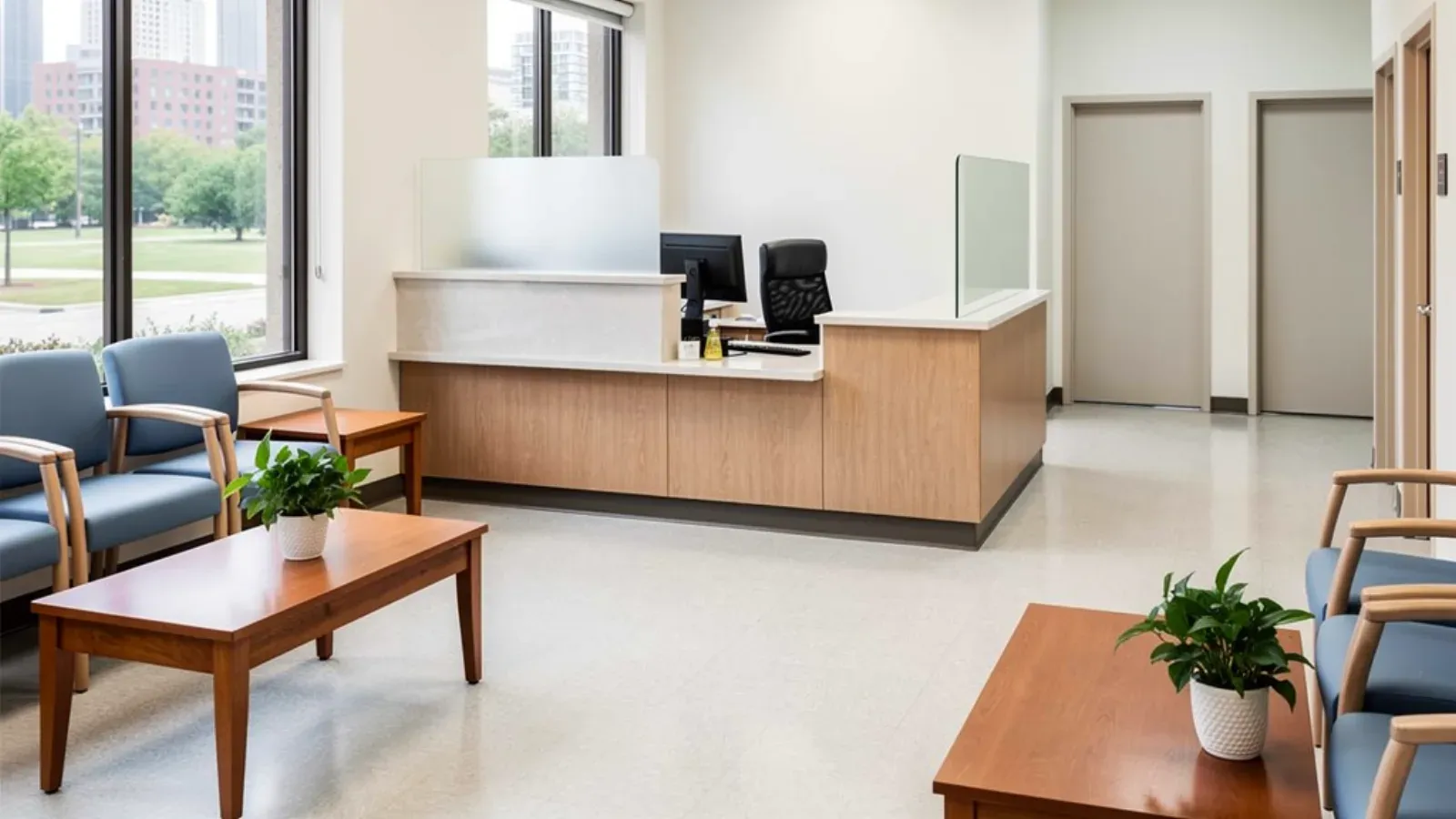
Abuse-resistant, impact-resistant, mold-resistant: where each belongs
Clinical drawings rarely call for plain gypsum. Corridors that take gurney and cart impact get abuse- or impact-resistant board rated to ASTM C1629 (National Gypsum Hi-Abuse / Hi-Impact, CertainTeed Extreme). Wet walls near sterile processing, soiled utility, and mechanical rooms get mold- and moisture-resistant board (USG Mold Tough, Fiberock). Behavioral-health areas have their own impact and ligature considerations. Reading the spec and putting the right board in the right wall, instead of substituting standard board to shave material cost, is what separates a healthcare-capable sub from a generalist. The right board goes in at the rated level the architect specified, documented.
Lead-lined and fire-rated assemblies
Imaging rooms (X-ray, CT, dental cone-beam) require lead-lined gypsum installed to a physicist’s shielding report: correct lead thickness, lead-backed seams, shielded fasteners, and continuity carried around every penetration so there is no shielding gap. Corridors, shafts, and occupancy separations require UL-listed Type X or Type C fire-rated assemblies built to the exact listed detail, fire-stopped at penetrations, and inspected before cover. These are built to the listing, not from memory, with the documentation the authority having jurisdiction and the facility need handed off.
Working around live clinical operations
The constraint that drives healthcare drywall is that the department usually cannot close. The work phases (nights, weekends, or segmented zones) so the clinic keeps running, and each segment is contained, completed, cleaned to clinical standard, and cleared before the next opens. Framing, fire-stopping, and cover inspections are sequenced with the GC and the New Haven Building Department so cover-up never gets ahead of sign-off and the project schedule holds. For private practices in the Temple Medical district and at 300 George Street, the same discipline applies even when it is the suite next door, not a hospital floor, that has to stay open. What a facilities manager or healthcare GC is buying is predictability: containment that holds, board that meets spec, inspections that pass, and a clinical area handed back clean.
Materials & standards
Products & materials we use
- USG Sheetrock Mold Tough / Fiberock (mold/moisture-resistant)
- National Gypsum Gold Bond Hi-Abuse / Hi-Impact (abuse/impact-resistant)
- CertainTeed Extreme Abuse / Impact board
- Ray-Bar lead-lined gypsum (imaging shielding)
- USG / National Gypsum Type X and Type C fire-rated board
Standards & codes we work to
- ICRA (Infection Control Risk Assessment), CDC/ASHE guidelines, Class I–IV
- ASTM C1629 (abuse/impact-resistant gypsum classification)
- GA-216 finishing standard (Level 4 / Level 5)
- UL fire resistance directory (listed assembly details)
- IBC Section 707 (fire partitions) / 709 (fire-rated assemblies); CT State Building Code 2022
- CT OHS Certificate of Need (drives the healthcare construction pipeline)
- New Haven Building Department (200 Orange St), commercial permit and inspection sequencing
- IBC Business (B) and Institutional (I-2) occupancy classifications
What the terms mean
- Containment class / hard barrier / anteroom / negative air / HEPA
- Tenant improvement (TI) / build-out / phasing
- Abuse-resistant vs. impact-resistant vs. standard board
- Fire-rated assembly / shaft wall / occupancy separation / fire-stopping
- Backing / blocking for casework, wall protection, handrails
- COI (certificate of insurance) / submittals
The work this involves
The techniques that go into a project like this:
Frequently asked questions
Do you understand ICRA, or is that something we would have to manage? +
We work to the facility's ICRA matrix directly. That means establishing the containment class the assessment calls for (hard barriers, anteroom, negative air with HEPA, controlled traffic) before demolition starts, and maintaining it through every phase. We coordinate with your infection-control lead on monitoring and do not relocate containment until the area passes inspection. For Class III and IV occupied-area work, this is the core of the job, not an add-on.
Can you work around our operating hours so the department does not close? +
Yes. Most occupied-building healthcare work we do is phased and after-hours (nights, weekends, or segmented zones) so the clinical area keeps running. We plan the phasing with you up front so each segment is contained, completed, cleaned, and cleared before we move to the next.
Do you handle abuse-resistant and impact-resistant board, and do you know where each belongs? +
Yes. Abuse-resistant and impact-resistant board (rated to ASTM C1629) goes where the drawings and traffic call for it: corridors, gurney-impact zones, behavioral-health areas. We install to the rated level the spec requires and do not substitute standard board to save material cost.
Can you also do the lead-lined imaging rooms? +
Yes. Lead-lined gypsum for X-ray, CT, and dental imaging is installed to the physicist's shielding report: correct lead thickness, backed seams, shielded fasteners, and continuity at penetrations. It is frequently part of the same suite build-out.
Are you licensed and insured for commercial healthcare work in Connecticut? +
Yes. We are CT-registered, with commercial general liability and a COI provided on request, bonded where the project requires it. We are set up to be added to a healthcare GC's sub roster and to satisfy facility credentialing.
Will you hold up our inspection schedule? +
No. We sequence framing, fire-stopping, and cover inspections with the GC and the building department so cover-up does not happen before sign-off. Fire-rated assemblies are built to the listed UL detail and documented for the AHJ.
We are a private practice, not a hospital. Is this still the right page? +
Yes. Dental, imaging, dermatology, orthopedic, and primary-care suites in buildings like 300 George Street and the Temple Medical district need the same clinical-grade approach: abuse-resistant corridors, mold-resistant wet walls, lead-lined imaging, and dust control if the suite next door is seeing patients.